
The power of Curly Fries
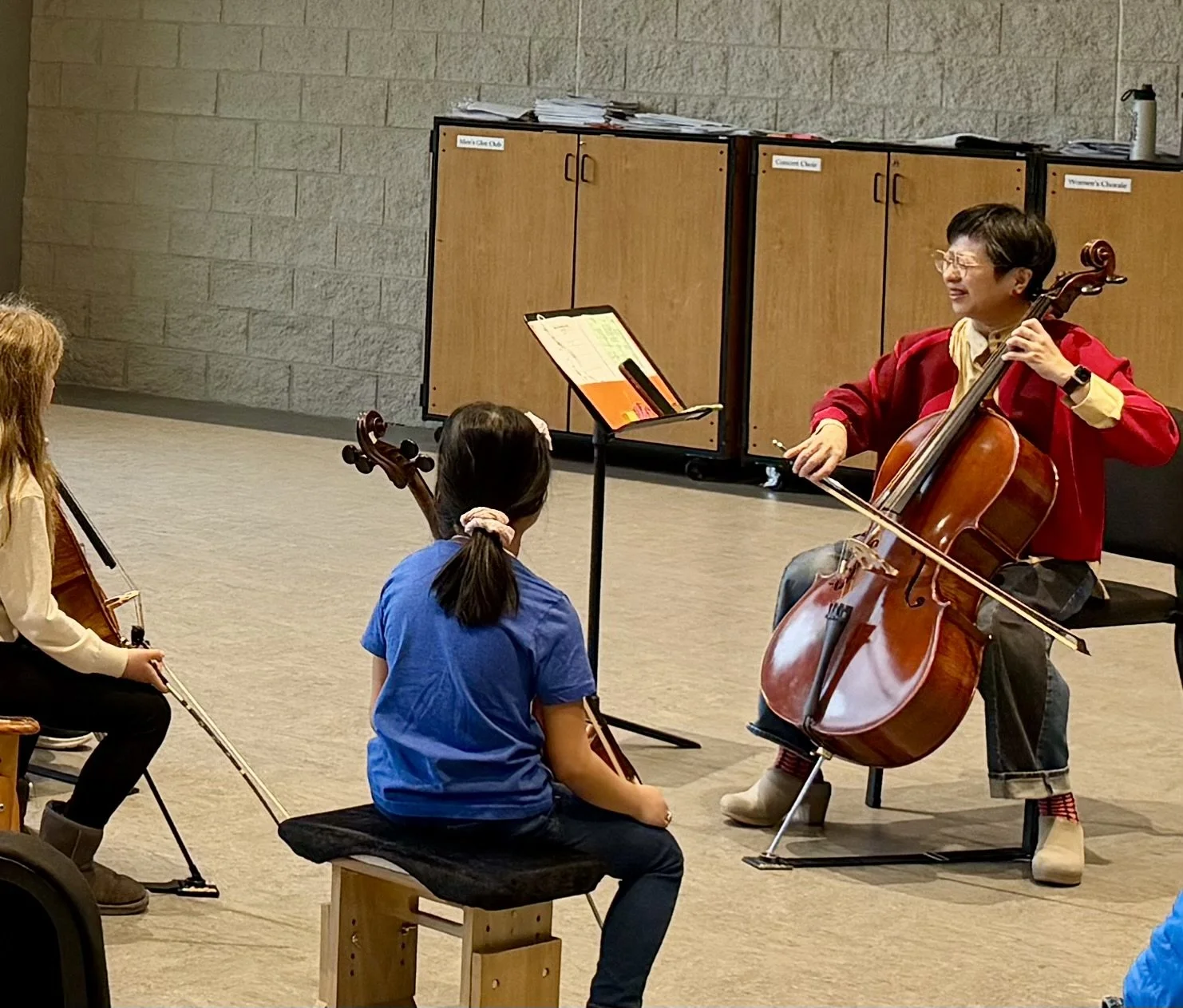
What is your cello world like?
A teacher’s journal on not giving up on questions—and gently discovering a student’s cello world
Teaching cello well is really not about how grandiose our ideas are—especially if those ideas do not inspire a student to open to their own senses and awareness.
But in order to do that, something shifted for me during a lesson just the other day.
A question came to me:
I wonder what this child’s “cello world” is like.
Yes—every cellist must have their own individual cello world.
With their own colors, sceneries, and settings. It is so fun to imagine there is such a thing as a cello world……
So I began to wonder…
Why does it always take him a while to notice that his bow hold turns into that curly fries shape whenever he plays something more challenging?
And if there is a cello world in his mind—
how do I get into it?
Will he invite me in?
This student has some big audition music coming up soon, and the first required piece is a whole bow etude.
I have been bothered by his naturally curled-up, tight bow grip for quite a while.
Feeling frustrated for not having the magic to make it go away—yet.
So this time, instead of jumping on commenting on it, and correcting it right away as most of the teachers do(as it is our duty)
I paused.
I suggested we both do windshield wipers—a familiar bow arm warm-up.
And while we were moving, I asked:
“When you turn the bow outward, which finger(s) carry the most weight?”
He was able to describe right away:”It’s the thumb and the pointer.”
“Yeah, that’s how I feel, too…. how about turn it inward?”
He had no trouble answering:”The pinky and the thumb?”
Then I invited him to watch me drawing a whole bow on an open G string.
While shaping a clear crescendo with the whole bow, I asked him:
“Do you notice anything about the angle of my bow hand as I draw the bow out toward the tip?”
At first, he had a hard time describing it:”It looks different from mine….”
He couldn’t quite articulate how my hand looked compared to his when drawing out the bow.
(Mine became more and more pronated.
His remained flat on the bow stick—therefore not producing a deep tone.)
So I gently pointed him toward something more specific:
“Maybe look at how the angle of my base knuckle changes…”
And then—he saw it.
He realized his hand looked more flat on the bow.
I was so happy to see him observe a major difference in our bow hold
without me filling in the blank or answering for him.
So instead of explaining, I invited him into an experience.
“When you try to make a louder tone with a smooth long bow, where is the bow arching from?”
He looked really focused. But it’s focused as if he’s having a conversation with himself.
He asked:”Was it anchored on the thumb?
The pointer?”
He wasn’t sure. But he was comfotable to think out loud. I just loved that!
So I offered just a small nudge:
“Maybe… are we anchoring on the string your bow is on?”
Then I asked him again:
“Can you describe which fingers are working harder than others as you draw the bow very slowly?”
Something began to shift.
I could feel it.
His confidence in describing what he felt started to grow.
He became more observant.
More focused.
He was moving his bow as if he had just discovered a completely new sensation of bowing.
It was fascinating to watch him become so absorbed in his own playing.
And in that moment, I felt like…
Maybe I was being invited into his cello world.
So I knew the time had come.
I invited him to apply this deep, connected and anchored long bow to his whole bow etude.
But the moment he started reading the piece…
The curly fries came back.
Immediately.
And I knew why.
His brain had shifted to:
“Let me read all the notes correctly so I don’t make any mistakes.”
And the bow hand—his awareness—got left behind.
So I gently asked:
“Where is that anchor?”
Right away, his fingers softened.
The sound deepened. Oh, and it was so focused and deep! His parent and I were both marvled.
Two measures later—it happened again.
This time I just quietly said:
“Oh……. curly fries………”
And his bow hold immediately melted into a professionally looking, well-pronated grip, and that was the moment I realized:
The solution was never the correction.
It was the questions.
Because every time I asked—
not to test him,
not to fix him,
but to understand his cello world—
he became more aware.
More connected.
More open.
Is teaching about having the right answers? Is teaching about pointing out what’s wrong and correction?
Maybe it’s about staying long enough in the question
until the student begins to feel, notice, and share their own experience.
Because once they do—
they are no longer just obeying instructions.
They are opening a window to offer a view inside their own cello world.
And when that happens…
Even curly fries can begin to melt.
What’s your cello world like?? Le't’s connect to build a fun cello teacher’s world together.
